Vet Neurologist Exposes The Hidden Cause Of IVDD Nobody Tells Dog Owners About — And Why Ramps And Baby Gates Were Never Going To Protect Your Dog's Spine
Neurologist whose own French Bulldog went from chasing his ball to dragging his back legs in a single night reveals the "Ramp-and-Wait Playbook" — and the daily scoop she now gives every short-legged dog she loves (without months of crate rest, painkillers, or $12,000 spinal surgery)
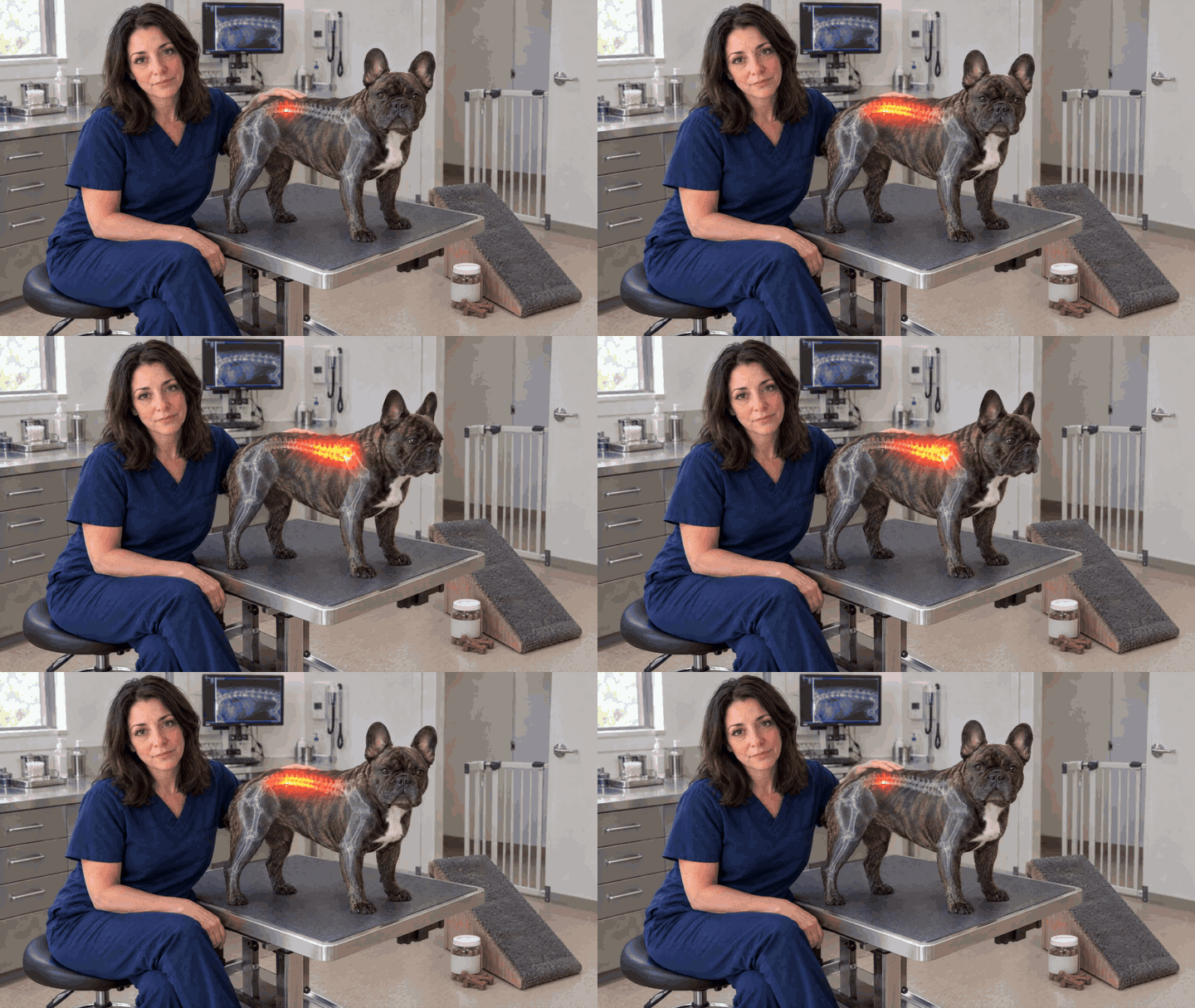
WARNING: If your dog is a French Bulldog, Dachshund, Corgi, Beagle, Basset Hound, Shih Tzu, Chihuahua or Pekingese — or a mix of any of them — he was born carrying a gene linked to up to 51× higher odds of a spinal disc rupture. Every month nothing is done, the damage inside his discs keeps building. Silently. With nothing for you to see until the night it goes.
I'm about to upset a lot of people in veterinary medicine.
Because what I'm about to tell you goes against the one piece of advice every owner of these breeds is given:
"Buy a ramp. Keep him off the sofa. And wait."
I followed that advice. With my own dog.
After watching Bruno, my four-year-old French Bulldog, go from chasing his ball at 9 PM to dragging his back legs across the kitchen floor at 2 AM…
After $11,400 on an emergency MRI, spinal surgery and eight weeks of crate rest…
After carrying him into the garden in a towel sling three times a day, because his legs simply would not hold him…
After lying on the kitchen floor next to his crate at night, listening to him whimper, and knowing I had told a hundred owners before me to "just keep him off the furniture"…
I discovered something that changed the way I look at every short-legged dog that walks into my clinic.
And if you're reading this with your dog asleep next to you — the one who jumps off the sofa ten times a day, who seems completely, perfectly fine…
The next 5 minutes could be the most important thing you ever do for his back.
My name is Dr. Emily Rodriguez. I'm a veterinary neurologist, and IVDD is what I do — the spinal disease that takes the back legs out from under Frenchies, dachshunds and corgis.
I've performed hundreds of spinal surgeries. And I've watched hundreds of owners break down in my office when I tell them it's $10,000 — with no guarantee.
And I'm about to show you what is really happening inside your dog's spine right now — and why the ramp, the baby gates and the joint chew were never going to reach it.
But first, let me tell you about the night that broke me…
THE NIGHT EVERYTHING CHANGED…
It was 9:14 PM on a Tuesday in October.
Bruno was doing what Bruno always did. Racing up and down the hallway after his ball, skidding on the rug, launching himself onto the sofa and off it again like the floor was lava.
Four years old. Never a limp. Never a yelp. The healthiest dog I had ever owned.
At 2 AM I woke up to a sound I will never forget.
Not a bark. A scream.
I found him in the kitchen. His front legs were pulling him across the tiles. His back legs were trailing behind him like they belonged to a different dog.
He looked up at me like he was asking what he had done wrong.
I'm a neurologist. I knew exactly what I was looking at before I had even switched the light on.
And I just stood there.
Useless.
A spinal specialist who had done everything "right" with her own dog.
Because I had. I had done all of it:
The ramp at the sofa. $89, carpeted, the good one. He used it to go up. He jumped off the other side to come down, every single time.
Baby gates on the stairs. Top and bottom. He never touched a stair in his life.
A harness instead of a collar. Since he was twelve weeks old.
A hip and joint chew every morning. $38 a tub, month after month, for four years. Glucosamine, chondroitin, a sprinkle of turmeric. Built for hips. Bruno's problem was never in his hips.
A perfect weight. Weighed every month. Not a gram over.
None of it mattered.
And the experts weren't any better.
The colleague I trusted most told me it was "just bad luck with the breed". The rehab centre told me to "keep the ramp and wait". Every textbook on my shelf said the same thing: it's genetic, and there's nothing to be done until it happens.
What came next was the part I had described to owners a thousand times and never once lived through.
The emergency MRI — $2,800 at 4 AM. A ruptured disc between two vertebrae in his lower back, pressing straight into the spinal cord.
The surgery — $7,200 the same afternoon. Performed by a colleague, because you do not operate on your own dog.
Eight weeks of crate rest — a dog who had never sat still for eight minutes, locked in a crate in the kitchen while I stepped over him every morning.
The medication list — anti-inflammatories, pain relief, muscle relaxants, and a sedative to keep him calm enough not to hurt himself again.
The rehab — hydrotherapy twice a week, $1,400 more. Carrying him out to the garden in a towel sling so he could go to the toilet.
$11,400 in total. And my colleague's words the day after surgery:
"The good news is he might walk again. The bad news is that half of these dogs have another episode. Keep him off the furniture."
Keep him off the furniture.
The same advice. The same advice that had already failed.
And here is what I could not get out of my head, lying on the kitchen floor next to his crate that night:
It is not just Bruno.
I went looking in the owner groups. The public French bulldog groups, the dachshund forums, the corgi pages. And I found the same night, over and over again, written by owners who had done everything right.
"Nicholas was fine before bed. Came in from potty and had a little wobble so I crated him. Came home from work to him shaking. He has never walked again despite surgery."
"Within about 3 hours she went from walking to paralyzed. It was SO fast."
"He acted totally fine once we got home. He tried playing and was eating and drinking normally." — four hours later that owner woke up at 5 AM to her four-year-old boy shaking on the floor.
And the one that made me put my phone down:
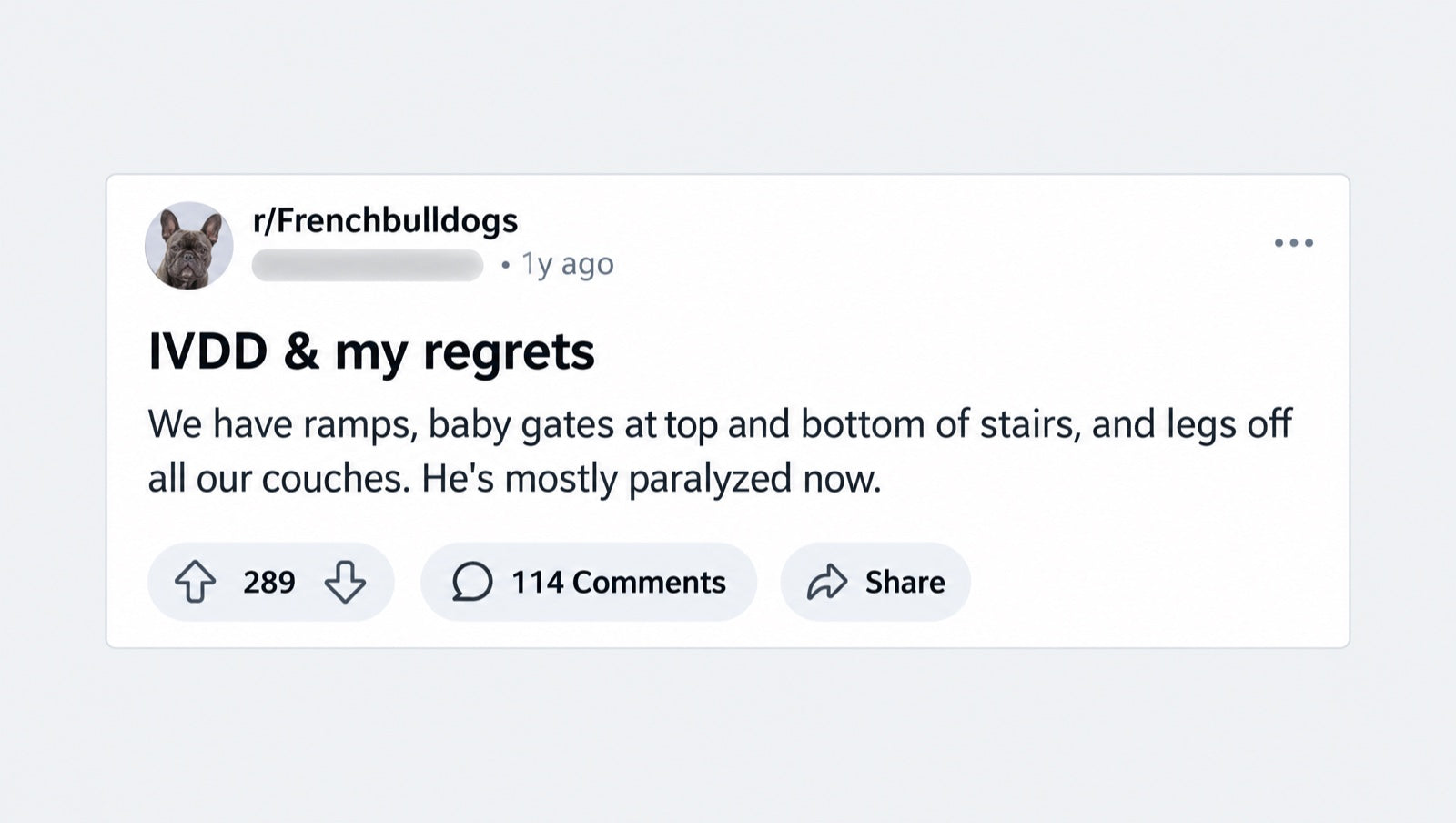
"We have ramps, baby gates at top and bottom of stairs, and legs off all our couches. He's mostly paralyzed now."
Ramps. Gates. Harnesses. Joint chews. Owners who had read everything.
"My husband and I have done everything in our power to avoid IVDD."
"I researched Frenchies for a long time. I knew IVDD was a reality."
That night, looking at the dog I loved, flat on his side in a crate on my kitchen floor…
Something inside me snapped.
I was not going to accept that the only answer my own profession had for these dogs was a ramp, a gate, and waiting for the night it happens.
I was not going to watch Bruno go through that a second time.
I was not going to keep telling owners "just keep him off the sofa" when I had just watched that advice fail in my own kitchen.
I was going to find out what was actually happening inside that disc.
Or die trying.
THE MIND-BLOWING DISCOVERY
For the next four months, I lived like a woman possessed.
I read every study on disc degeneration in these breeds I could get my hands on. I called researchers in New Zealand, Finland and the US. I sat up until 3 AM with Bruno's crate next to my desk, going through papers owners never get to see.
And what I found made me want to throw my textbooks in the bin.
The way we talk to owners about IVDD is built on a half-truth.
Here is the half everybody tells you: it's genetic.
And that part is true. In 2017 a team at UC Davis found the gene. A retrogene called FGF4, sitting on chromosome 12 — the same piece of code that gives these breeds their short legs also changes the cartilage in the middle of every spinal disc. In their data it carried an odds ratio of 51.23 for disc disease.
Fifty-one times the odds. Your dog did not develop this. He was born holding it. There is even a cheek swab test for it, and almost no owner of these breeds has ever been told it exists.
And because it's genetic, every owner gets the same line: "There's nothing you can do. Protect him from the outside and hope."
Here's what they don't tell you:
IVDD is NOT just a genetic problem you protect your dog from on the outside.
IVDD is an INFLAMMATION problem — enzymes cutting the disc apart from the INSIDE, in the one tissue in your dog's body his bloodstream can barely reach.
Every veterinary neurologist knows the disc is fed by diffusion. Every one of us knows inflammation drives the breakdown. It is in the textbooks.
A 2023 study from Finland showed exactly how early it starts. Twenty-one young dachshunds. All two to two and a half years old. All completely healthy — no pain, no limp, nothing. Every one of them went through an MRI and 546 individual discs were graded.
Eleven came back normal. Eleven out of 546. Ninety-eight per cent of the discs in a group of healthy, bouncing two year olds had already changed.
But owners still walk out of the clinic with the same advice. Buy a ramp. Keep him off the sofa. Wait.
Because the REAL cause is something so simple, so fixable, that it doesn't fit in a ten-minute check-up or on a $38 tub of hip chews.
That's why the "solutions" never actually protect the disc.
And no — this is not a dachshund story. The same gene sits in more than forty breeds:
Highest adjusted odds of any purebred in a study of 43,517 dogs. 30% of their ruptures are in the neck, against 2% in dachshunds. Mean age at referral: 3.8 years.
Same chromosome 12 variant as the dachshund. Owners watch the hips. That bunny hop can be the back.
On the elevated-risk list since 1976, and they hide pain for weeks.
Nobody files these as back breeds. They have the highest neck shares there are.
Mixes carrying the variant had the highest relative risk of any group measured.
Your dog's discs are being cut apart from the inside — and everybody is handing you tools for the outside.
THE REAL ROOT CAUSE OF IVDD (THAT NOBODY TELLS YOU)
Let me break this down in terms anyone can understand.
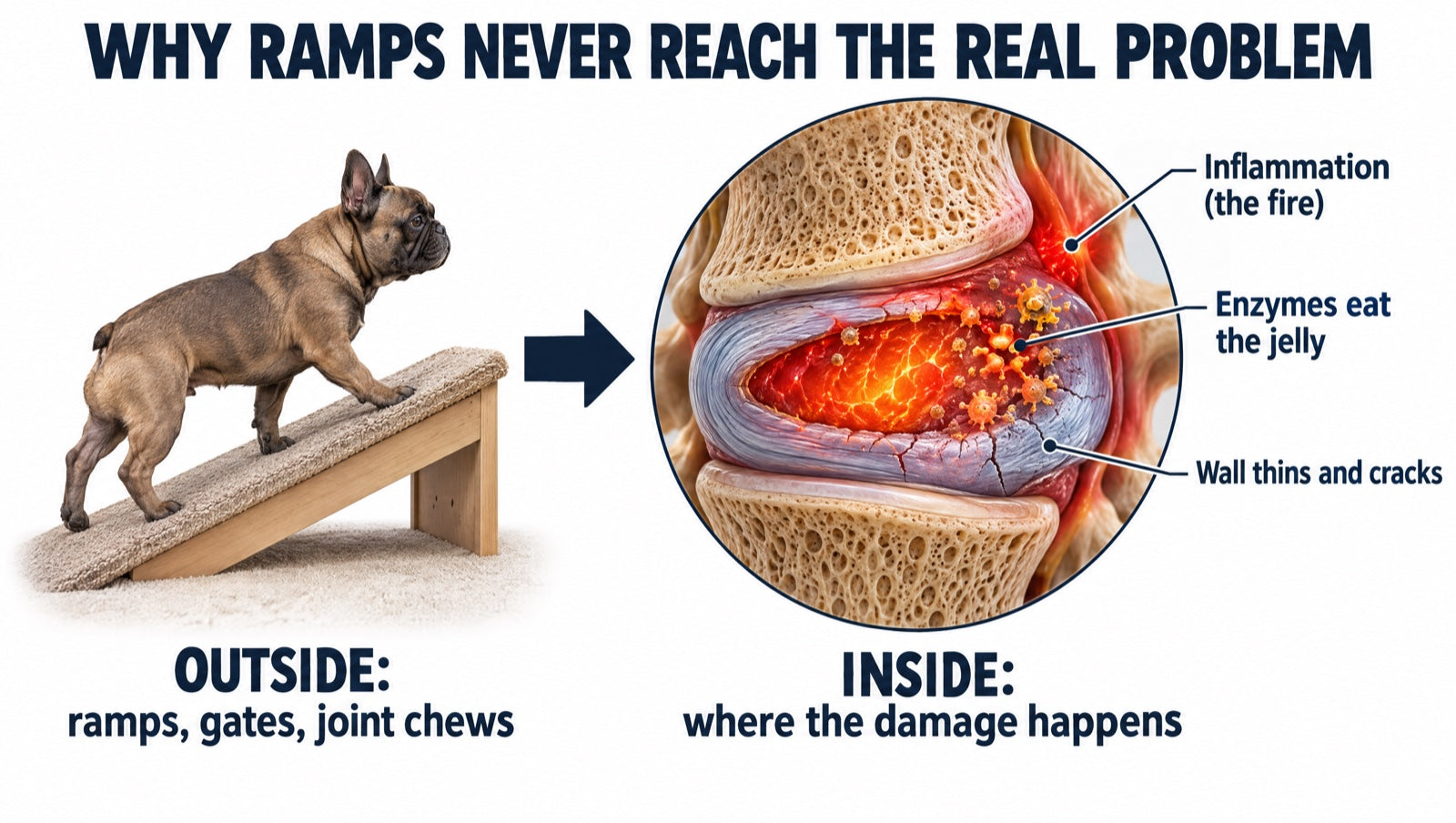
Picture every disc in your dog's back as a jelly doughnut held inside a wall of woven rope.
The jelly is the shock absorber. Every time your dog lands off the sofa, it spreads the load so the bones never touch. The rope wall keeps the jelly where it belongs. As long as that wall holds, your dog runs, jumps, twists, and nothing happens.
Now meet the enemy. A family of enzymes called matrix metalloproteinases — MMPs. Their normal job is to clear away old tissue so new tissue can replace it. But inflammation — a slow fire that starts burning inside the disc before your dog is even a year old — switches them on, and once they are switched on and stay on, they cut the fibres of that rope wall from the inside. Strand by strand. Day after day. Year after year.
When everything works, the disc would repair what the enzymes cut. But the disc has a problem no other tissue has: it has almost no blood supply of its own. Blood can't rush in to carry the damage away. The disc is fed only by slow seepage from the bone above and below it.
So the wall is being cut faster than it can ever be rebuilt. And the weapons you've been given are useless against it.
You bought a ramp? OUTSIDE. It changes how he lands — if he uses it, which most dogs don't. It never gets near the enzymes.
You put up baby gates? OUTSIDE. The cutting carries on behind them.
You give a hip and joint chew? WRONG TISSUE. A joint has a capsule, a membrane and a fluid. A disc has none of those.
You keep him at a perfect weight, in a harness, on rugs? OUTSIDE. Every one of them.
There's no problem with how you look after your dog. No problem with your ramp or your gates. Just an enzyme attack on the inside of a disc that nothing on the outside can reach.
Here's what the science now says:
1. The damage starts before his second birthday.
A Danish team followed forty dachshunds with repeat x-rays for years. The hardening forms between six and eighteen months of age and reaches its maximum at about two. That is a puppy. The same dog who was chewing your shoes.
2. You will see nothing for years.
In a survey of 2,031 dachshunds, only 0.2% were diagnosed before two. By eight to ten years, 41.9%. For a French Bulldog, the average age at referral is 3.8 years. Four silent years where your dog looks, plays and behaves like a dog with a perfectly normal back.
3. When it goes, it goes in hours.
41.7% of dogs went from normal to diagnosed in under 24 hours. 69.3% could not walk by the time they were seen. Only 5.6% turned up with pain and nothing else. Fewer than one in twenty got a warning. That is why "watch him for signs" helps almost nobody.
4. The cutting never stops — it runs every single day.
The gene doesn't switch off. The inflammation doesn't take days off. As long as the enzymes are switched on, the wall is being cut — on the ordinary Tuesday, while he sleeps on the sofa, while you think everything is fine. And one ordinary evening, in the two seconds it takes to jump off that sofa, the wall runs out.
The jump didn't cause it. The jump was just the day the wall ran out.
And here's the kicker.
Inflammation runs down two main pathways in a dog. Fish oil supplies EPA and DHA, and those work on one of them. But there is a rare omega-3 called ETA — found in green lipped mussel from New Zealand and not present in fish oil in any meaningful amount — and ETA has been described as acting on both.
In the research, the mussel is described as acting like a shield on the enzymes — getting in their way so that tissue is not cut down faster than it is built.
And the mussel does more than put the fire out. It also carries glucosamine, chondroitin and glycosaminoglycans — the construction crew that rebuilds the walls the fire already damaged.
That means: the answer isn't another ramp. It's getting to the disc from the inside — through the only door it has, the bloodstream, every single day. First put out the fire. Then rebuild.
It has been sitting in the research for years.
And owners are still being handed the "Ramp-and-Wait Playbook":
Buy a ramp → block the stairs → give a joint chew built for hips → wait → the night it ruptures → $2,800 emergency MRI → $10,000+ surgery → eight weeks in a crate → "keep him off the furniture" → half of them do it all again
Not one step in that chain touches the thing that is actually destroying the disc.
THE INTERNAL SOLUTION HIDING IN PLAIN SIGHT
Remember Bruno, flat on his side in a crate on my kitchen floor?
Eleven months later, I took him to the beach. He ran the full length of it, chased every seagull he could find, and came back to me covered in sand with his tail going like mad.
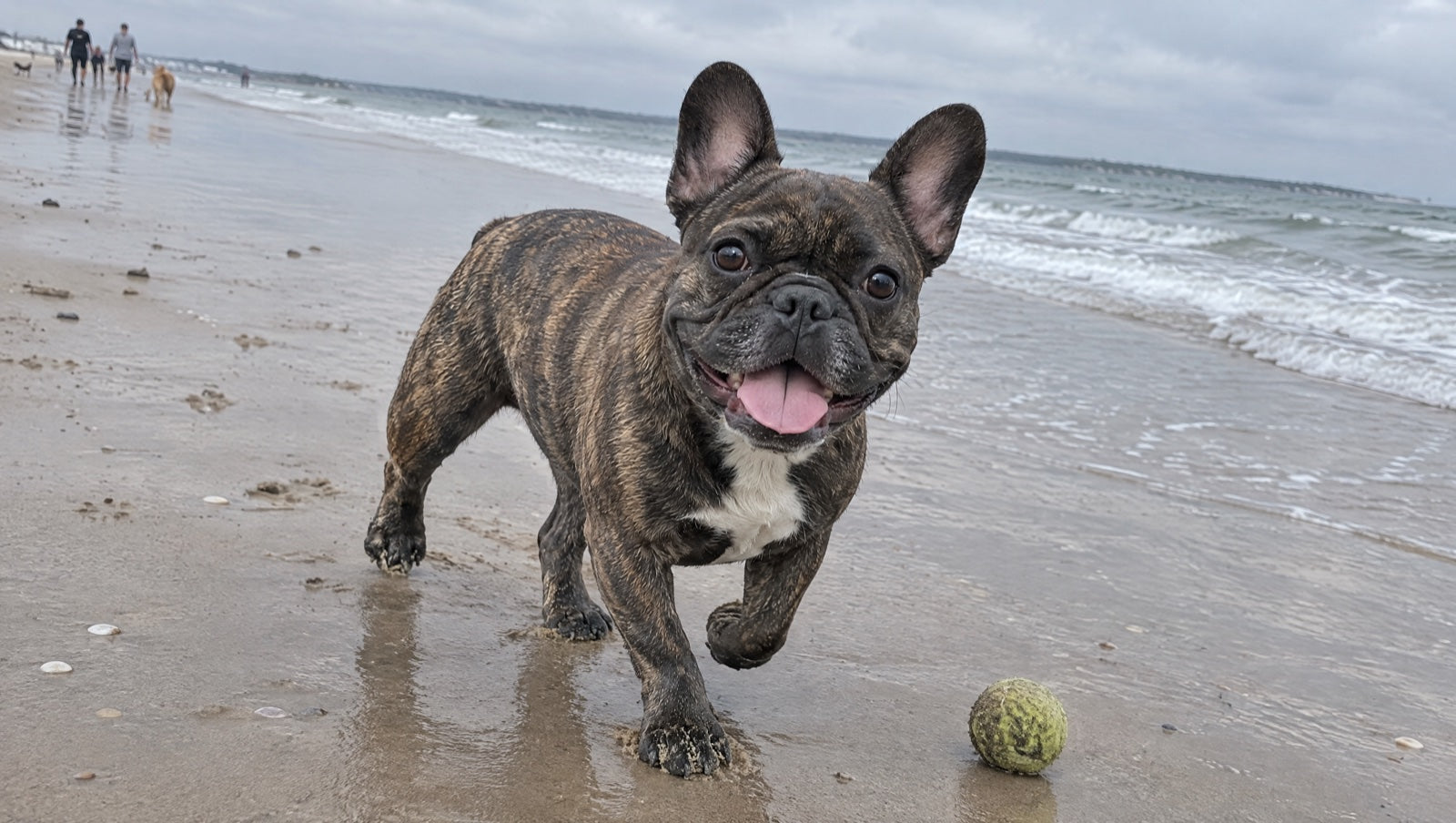
No more crate. No more towel sling. No more lying awake listening for that scream.
One thing I didn't expect: in month four we ran out for nine days while I waited on a new batch. By day six he hesitated at the step into the garden. By day eight he was stiff getting up from his bed again. I panicked. The day he was back on it, I watched him like a hawk — and within two weeks that little hesitation was gone.
That's when I understood something critical: this doesn't cure IVDD. Nothing does. The gene is in every cell of his body. What it does is put out the fire so the enzymes stop eating the disc — and then, once the fire is out, give the body what it needs to rebuild. Stop, and the fire starts again. Keep going, and the walls get the chance to rebuild and hold.
Bruno hasn't missed a single night since.
Just one change to what was reaching his discs every single day.
Something so stupidly simple, I'm embarrassed it took me a whole career in neurology and my own dog on the kitchen floor to see it.
To actually protect your dog's spine — not just from the outside, but where the damage is really happening — you need to do ONE thing:
PUT OUT THE FIRE, THEN REBUILD. Stop the inflammation and the enzymes eating the disc — and then feed the disc what it needs to heal, every single day.
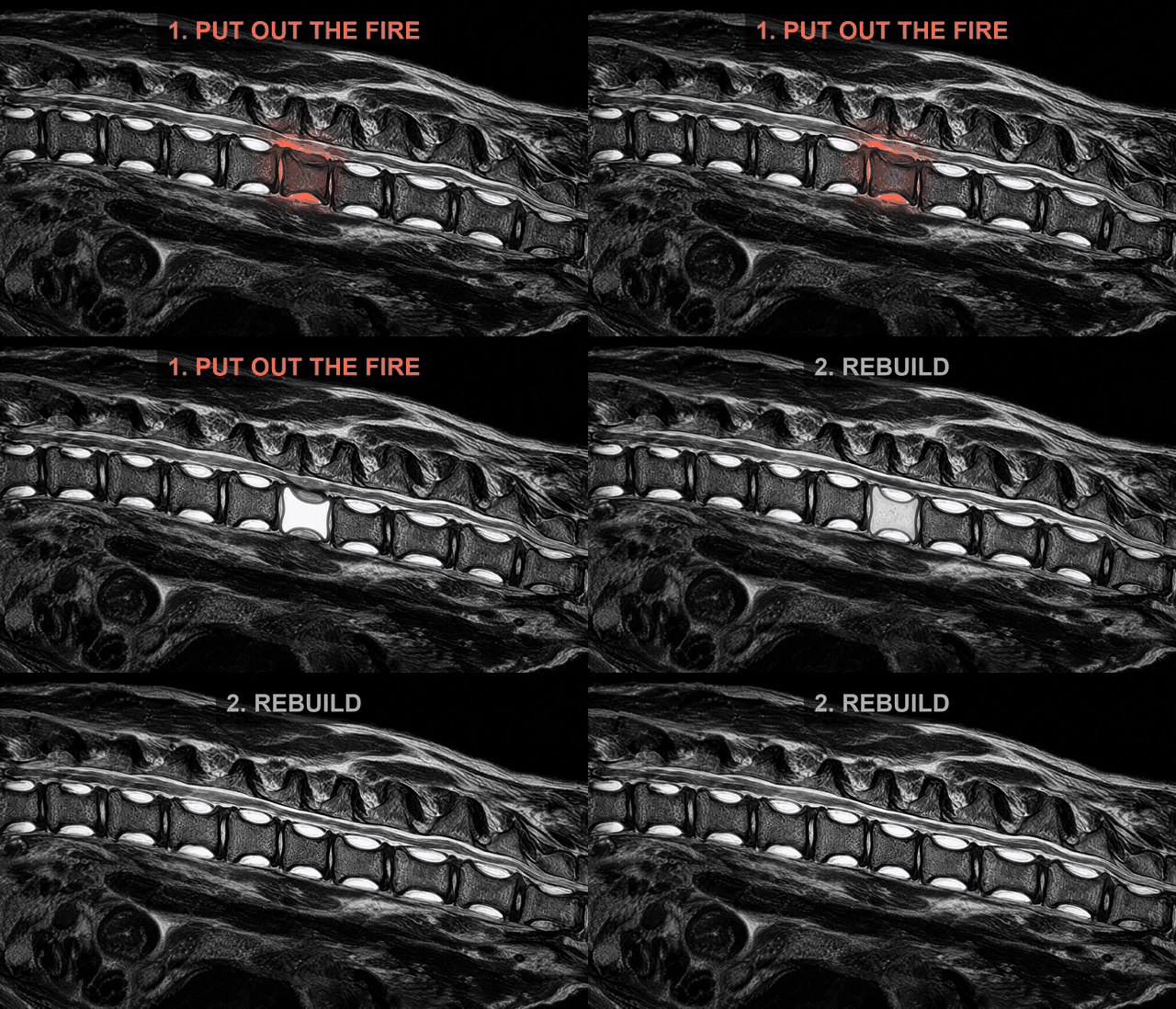
Illustration: what the fire and the rebuild look like inside the disc.
Every day, the enzymes cut. The disc can't repair fast enough. The ramp can't reach it. The wall thins. And one ordinary night, it goes.
As long as that fire is burning, everything else you do is like putting a Band-Aid on a broken pipe. So you put the fire out first. That's the most important thing.
And once the fire is out and the enzymes stop, the body can finally start rebuilding. Glucosamine rebuilds the walls. Chondroitin pulls the fluid back into the jelly. Glycosaminoglycans lock everything in place, so the cushion stays bouncy.
Put out the fire. Then feed the disc what it needs to heal. Through the only door it has.
You need something specifically designed to:
Deliver ETA — the rare omega-3 shown to act on both inflammation pathways, not just the one fish oil reaches.
Reach the disc from the inside — through the bloodstream, the only route into a tissue with almost no blood supply of its own.
Rebuild the walls — glucosamine, chondroitin and glycosaminoglycans, the construction crew that repairs the walls and pulls the fluid back in.
Work every single day — because the fire never takes a night off, and neither can the protection.
Arrive as a whole food — not a fourteen-ingredient chew with a sliver of everything and a dose of nothing.
THIS DISCOVERY IS SPREADING THROUGH EVERY SHORT-LEGGED BREED GROUP
After Bruno, word spread fast.
A man named Mark messaged me after his five-year-old corgi, Tilly, started knuckling her back paws on walks. His vet had already mentioned surgery. "I'll try anything before I put her through that," he wrote. He started her that week. Two years later, he sent me a video of her flying off the sofa to get to the doorbell. "My vet asked what we'd changed," he wrote. "I sent him your article."
Within months, owners were messaging me from every breed group there is.
Frenchie owners who had already been through one surgery and were terrified of the second…
Dachshund owners who had been told "it's not if, it's when" by their own vet…
Corgi owners who had spent years buying hip chews for a problem that was never in the hips…
A retired couple with a seven-year-old basset who had quietly stopped jumping on the bed and never jumped again…
Owners of rescues and mixes who had been told "he'll be fine, he's not a pure breed"…
Different breeds. Different ages. Different stories. And the same message, over and over: "I wish someone had told me this sooner."
WHY THE SUPPLEMENT AISLE WILL NEVER TELL YOU THIS
Walk down any pet supplement aisle. Every tub on it is built for hips.
Because hip and joint problems affect every dog there is — labradors, shepherds, retrievers, all of them. Disc disease of this kind hits about forty breeds. If you're building a product to sell to every dog owner in the country, you build for hips, you put a running labrador on the front, you write "MOBILITY" in big letters…
And you let every Frenchie, dachshund and corgi owner assume it covers the spine too.
It doesn't. Your dog's problem was never the one that aisle was built for.
Then there's the second thing. The active part of green lipped mussel is a delicate marine oil. Heat-drying it is fast, cheap and high-yield — and it damages exactly the part you're paying for. Cold-processing is slower, lower-yield and ties up the line. So almost nobody does it. And almost none of those tubs tell you on the label how their powder was dried.
They had no reason to build the thing your dog actually needs.
So I did. A solution that:
Goes after the ROOT CAUSE — the enzymes cutting the disc from the inside, not just the load on the outside.
Works in one scoop a night — not in an emergency clinic at 2 AM billing $2,800 for a scan.
Costs less than one month of the hip chews you're already buying for the wrong tissue.
Lets you protect his discs at home — in his dinner bowl, not on a surgical table.
So I spent the next months turning that research into one simple daily scoop.
THE SCOOP THAT'S MAKING RAMPS OBSOLETE

One ingredient, one scoop. There is nothing else in the tub.
It's called Spine & Disc Powder.
It's not a hip and joint chew with a spine on the box.
It's not a watered-down fish oil.
It's a single-ingredient, cold-processed green lipped mussel powder from the Marlborough Sounds in New Zealand — built for one job: getting a shield to the disc from the inside, every single day.
Here's what makes it different:
ETA — THE BRAKE ON THE ENZYMES. A rare omega-3 found in green lipped mussel and not in fish oil in any meaningful amount. It acts on the second inflammation pathway fish oil leaves wide open — the link in the chain that is cutting the wall.
DELIVERY FROM THE INSIDE. A ramp works on the outside. This works through the bloodstream — the only door into a disc with almost no blood supply of its own.
THE CONSTRUCTION CREW — REBUILDS THE WALLS. Once the fire is out, the rebuilding starts. Glucosamine rebuilds the disc walls. Chondroitin pulls the fluid back in, so the jelly holds its water instead of going hard. Glycosaminoglycans lock the walls in place so the cushion stays bouncy. Nobody added them. They're in the mussel because they're in the mussel.
COLD-PROCESSED, NOT HEAT-DRIED. Dried slowly at low temperature, so the delicate marine oil — the part that does the work — arrives intact.
ONE SCOOP, EVERY NIGHT. A fine powder that goes into wet or dry food. Eight seconds. Most dogs eat it without looking up.
In a 2022 systematic review of 72 clinical trials, glucosamine and chondroitin taken on their own came out consistently ineffective for joint pain in dogs and cats. Omega-3 was the only category that worked. That's why this is not another glucosamine tub. And Cornell University confirms green lipped mussel helps dogs with arthritis at 77mg per kg of bodyweight daily.
Here's what most owners don't understand — and what I wish somebody had told me the day I brought Bruno home as a puppy:
The gene is not an illness you beat once. It's permanent. It's in every cell of his body and it will be there for the rest of his life. You can't cure it. You can't ramp your way around it.
What you CAN do — the only thing that actually reaches the disc — is keep the shield on the enzymes every single day, so they never get a free run at the wall.
Think of it like blood pressure medication. You don't take it for sixty days and stop because the numbers look good. The numbers look good BECAUSE you're taking it.
Spine & Disc Powder works the same way. This isn't a flaw. It's exactly why it works where a ramp can't — a ramp is one object on the outside, and this is a shield on the inside every single day.
Here's the timeline most owners experience:
Week 1–2: The Start. One scoop into his dinner. The ETA starts building up in his blood and seeping into the discs from the edges. You won't see much yet — this is the part that happens on the inside.
Week 3–4: The Fire Goes Out. Omega-3 levels in his blood are where they need to be. The inflammation calms down and the enzymes stop eating the disc. Most owners notice he gets up from a nap without that little stiff pause.
Month 2–3: The Rebuild Starts. With the fire out, the construction crew gets to work: the walls are repaired and the fluid is pulled back into the jelly. He takes the step into the garden without thinking about it. He's back to launching himself at the door when the doorbell goes.
Month 4–5: Stronger Walls, Bouncy Cushions. The walls keep getting stronger, the cushions stay hydrated and bouncy. A dog who runs, jumps and plays like a dog — with the fire out and the walls rebuilt.
Month 6+: Where Most Owners Stay. The tub arrives on repeat. The scoop goes in. You stop thinking about his back. But every long-term owner understands the same thing: the gene never switches off, so the fire always wants to come back. Stop, and it starts eating the disc again within weeks.
That's why most owners choose the subscription. Not because we push them — because once they understand the chain, they never want to leave that door open again.
THE RESULTS THAT HAVE VETS QUIETLY ORDERING FOR THEIR OWN DOGS
Our product page carries 2,847 reviews at an average of 4.9 stars.
And when you read them, owners keep writing about the same things. He gets up from his nap without that stiff pause. He takes the stairs again. He's back to launching himself off the sofa like nothing happened.
But here's what matters most: almost nobody asks for their money back.
Here's what real owners with verified purchases are saying:

Dental Hygienist · Austin, TX · French Bulldog
“Louie had his first episode at three. One night he was fine, the next morning he couldn't use his back legs. $9,000 later and eight weeks of crate rest, the surgeon told us half of these dogs go through it again. I spent the next year terrified every time he jumped off the couch.
A friend in our Frenchie group sent me this article. I started Louie on the powder the same week. That was 14 months ago. Not one episode. At his last check-up our vet said, whatever you're doing, keep doing it.
I'm not stopping. Ever. It's one scoop in his dinner and it's the first time since his surgery that I actually sleep through the night.”

Electrician · Columbus, OH · Dachshund
“Our vet told us straight up: with a doxie, it's not if, it's when. So we did everything. Ramps, gates, harness. Oscar ignored every ramp we bought and flew off the couch anyway.
What got me was the part about it happening on the inside. That's exactly what nobody ever explained to us. Oscar started on this when he was two. He's four now, still flying off that couch, and I don't hold my breath every time anymore.
Cheapest peace of mind I've ever bought.”

Retired Teacher · Scottsdale, AZ · Corgi
“Biscuit is seven and I thought she was just getting old. She stopped jumping on the bed and would stand at the bottom of the stairs looking at me like she needed help. I'd been giving her hip chews for years.
About eight weeks after we switched to this, I woke up and she was on the bed next to me. Just jumped up like she used to. I cried.
I'm on the subscription now. My daughter asked why I don't stop now she's better. I told her: she's better because she's on it.”
THE PRICE THAT'S MAKING THE RAMP-AND-WAIT PLAYBOOK LOOK RIDICULOUS
Let me show you what "protecting" a dog with this gene REALLY costs:
The Ramp-and-Wait Route:
Sofa ramp: $89
Baby gates, top and bottom: $120
Rugs over the hard floors: $200+
Hip and joint chews: $38 × 12 = $456/year
Total: $865 in year one, $456 every year after — and nothing reaches the disc.
The Surgery Route:
Emergency visit: $300–500
MRI: $2,000–3,000
Spinal surgery: $7,000–10,000
Hospital nights + medication: $1,000+
Rehab and hydrotherapy: $1,000–2,000
Total: $10,000–15,000 — and 52.7% have another episode.
The Insurance Route:
The UK breed council tells owners to insure for a minimum of £8,000 of cover — and says £10,000 is safer.
Every month, for life. And it pays out after the damage is done.
The Worst-Case Route:
A second surgery. A wheelchair cart: $400+. Months of rehab. A dog who never runs again.
No price tag makes up for that one.
Now here's the math that should make you furious.
You're already spending around $456 a year on chews built for the wrong tissue — or you're one ordinary night away from $10,000+.
Spine & Disc Powder is less than $1.20 a night. One scoop, every night, working on the inside where nothing else reaches.
Everybody in the Ramp-and-Wait Playbook makes money from the damage. The emergency clinic. The surgeon. The rehab centre. The insurer. Even the hip chew you rebuy every month.
Not one of them makes money if the wall never runs out.
Cold-processed green lipped mussel is not cheap to make. It dries slowly, it ties up the line, and it yields less finished powder per batch than heat-drying. That is why the regular price is $60.00.
Already less than a single vet consultation.
Already less than two months of the hip chews.
Already a rounding error next to one MRI.
But that's not what you'll pay today.
THE LAUNCH PRICE
I didn't build this to get rich off owners who are scared for their dogs.
I built it because I spent a night on my kitchen floor next to a crate, and I don't want you to spend yours there.
So during the launch, it's not $60.00.
$60.00 → Just $34.95
That's $25.05 off — the lowest this has ever been sold for.
Less than one month of hip chews.
Less than one hydrotherapy session.
Less than dinner for two.
The launch price exists to get the first few thousand tubs into the hands of owners who will tell us what happened. When that job is done, it goes back to $60.00.
BUT HERE'S THE BRUTAL REALITY. Cold-processed powder can't be rushed. Low-temperature drying yields less finished powder per batch, and every batch takes longer to run. When this batch is gone, the next one is not a button we press. It's weeks. If you're reading this, this batch is still available.
MY PERSONAL 90-DAY "STRONG BACK" GUARANTEE
Look, I get it.
You've been burned before. We all have. Tubs of hip chews at the back of the cupboard. A ramp he jumps off anyway. Promises on a label that never reached the part that matters.
So here's my promise — and I'm putting it in writing:
Try Spine & Disc Powder for 90 full days.
One scoop, every single night. Give the ETA time to build up in his blood. Give the shield time to go up.
On day one, write down how he gets up after a nap, how he takes the step into the garden, how he lands off the sofa.
Watch him get up without that little stiff pause…
Watch him take the steps like they're nothing…
Feel the relief of knowing something is finally working on the inside…
And if after 90 days you're not completely happy — for any reason at all — I'll refund every penny.
No forms. No "store credit". No questions. You don't even send the tub back.
Just reply to your order confirmation email with the word "refund". That's it.
Why am I this confident? Because almost nobody asks for it.
THE DECISION THAT WILL DEFINE HIS NEXT DECADE
Right now, you're standing at a fork in the road.

Path #1: Keep Doing What You're Doing
Keep buying hip chews for a problem that was never in his hips.
Keep hoping he uses the ramp this time.
Keep flinching every time he launches himself off the sofa at the doorbell.
Keep listening for a yelp in the night.
Keep the enzymes cutting, day after day, while he shows you absolutely nothing.
And one ordinary night — like Bruno, like Nicholas, like every "he was fine yesterday" post in those groups — you'll be standing in an emergency clinic at 2 AM, hearing the word "surgery," reading another article about another ramp.
Path #2: Protect Him From the Inside
Spend less than a month of hip chews.
Put a shield on the enzymes that are cutting his discs.
Fix the part nobody told you about — the inside.
Watch him run, jump and fly off the sofa like the dog he is, knowing something is finally working where the damage happens.
I think you know which path leads to a twelve-year-old dog still sprinting down the beach.
HERE'S EXACTLY WHAT HAPPENS NEXT

Eight seconds, on top of the food he already eats.
Step 1: Click the button below that says "CHECK AVAILABILITY NOW".
Step 2: Choose his weight. One scoop a day under 35 lbs, two scoops above it.
Step 3: Choose Subscribe & Save — the smart choice. 22% off every delivery and free shipping, cancel anytime. Because the enzymes never take a day off, you never want a gap in the shield.
Step 4: Enter your shipping details.
Step 5: When it arrives, give the first scoop TONIGHT, in his dinner. Don't wait. Don't "start on Monday".
But whatever you do, don't close this page thinking "maybe later".
There is no later when the wall is being cut every day.
"Later" is another month of the enzymes running free.
"Later" is another night he jumps off the sofa and you hold your breath.
"Later" is the 2 AM scream from the kitchen.
Nicholas was fine before bed. Your dog is fine before bed tonight too.
He has waited long enough for someone to protect the inside of his back.
The solution is one click away.
OFFER
To a long life on four working legs,
Dr. Emily Rodriguez
Veterinary Neurology & Rehabilitation
Bruno's owner
P.S. Bruno just stole a sock off the washing line and ran the full length of the garden with it. Last year I was carrying him out there in a towel. Your dog is fine tonight too. That is exactly why tonight is the night to start — not the night after it goes.
P.P.S. The launch price is $34.95 against a $60.00 list, and the reason there is not an endless supply of it is in the drying, not in a countdown. If you have read this far, you are not going to read it twice. Do it on this batch.
P.P.P.S. If you take one thing from this page and buy nothing at all, take this one. Your dog's back is not built like other dogs' backs, and most of the change happens before he is two. Tell the next owner of one of these breeds you meet. Almost nobody has been told.
P.P.P.P.S. The #1 mistake I see: owners start, feel good about it, and let the tub run out. The gene never switches off, so the shield can't either. Put it on repeat, and never leave link three open again.
WHAT OWNERS OF THESE BREEDS ARE SAYING TO EACH OTHER
Every line below is a real public post from a breed-owner group, quoted exactly as it was written, with first names changed so nobody gets identified. None of them are about our powder and none of them were solicited. I am putting them here because they are the conversation this article came out of, and because they say it better than I can.

I researched Frenchies for a long time. I knew IVDD was a reality. I bought ramps for furniture but she would only sometimes use them and insisted on jumping. I wish, I wish, I wish we had taken IVDD more seriously.

We have ramps, baby gates at top and bottom of stairs, and legs off all our couches. He's mostly paralyzed now so we just lift him off n on couches and bed lol
We found this out the hard way as our boy still had a bout of IVDD even though we had doggy stairs and low ottomans as intermediate levels to reduce jumping. But ANY jumping on or off furniture, even if it doesn't seem very high, can cause back issues.

Nicholas was fine before bed. Came in from potty and had a little wobble so I crated him. Came home from work to him shaking. He has never walked again despite surgery.

I have a frenchie. And this scares me, was there any signs it was coming?

Getting up and down seems so effortless for her, or so I thought.

He acted totally fine once we got home. He tried playing and was eating and drinking normally. I woke up at 5am to him clearly so uncomfortable and shaking.

We have tried numerous types. They simply refuse to use them. Sometimes with guidance I can get them to go up but coming down they are just adamant about not participating.

Mine yeet off the couch all the time. They won't listen.

We have the stairs for the sofa but they use em to get down half the time or less. Mostly they hear something, spot a squirrel and just leap off the couch like superman. Crazy little gremlins.

I feel so defeated as a dog mom. I feel like I failed him. I've been crying all morning because my sweet boy is in pain and I can't explain anything to him.

You have got to remember these are dogs that are high risk of IVDD because of their unique anatomy. This isn't something you can change. Consider yourself lucky that precautions you have taken may have played a role in the severity.

Please treat your frenchies like fine china 😭
Every one of those was written by somebody whose dog was fine last year. Learn more
Every figure marked on this page is drawn from published veterinary literature — Brown 2017 (PNAS), Batcher 2019 (Genes), Reunanen 2023 (Acta Vet Scand), Jensen & Arnbjerg 2001 (JAAHA), Wee & Nin 2025 (JAVMA, 43,517 dogs), Leu 2023 (Acta Vet Scand), Priester 1976 (Theriogenology) and the UC Davis CDDY breed list. Ask us for any of them and we will send the paper. This article is general information and is not a substitute for veterinary examination. Always talk to your vet. Advertisement, paid content from The Paw Parent.